
Field contamination
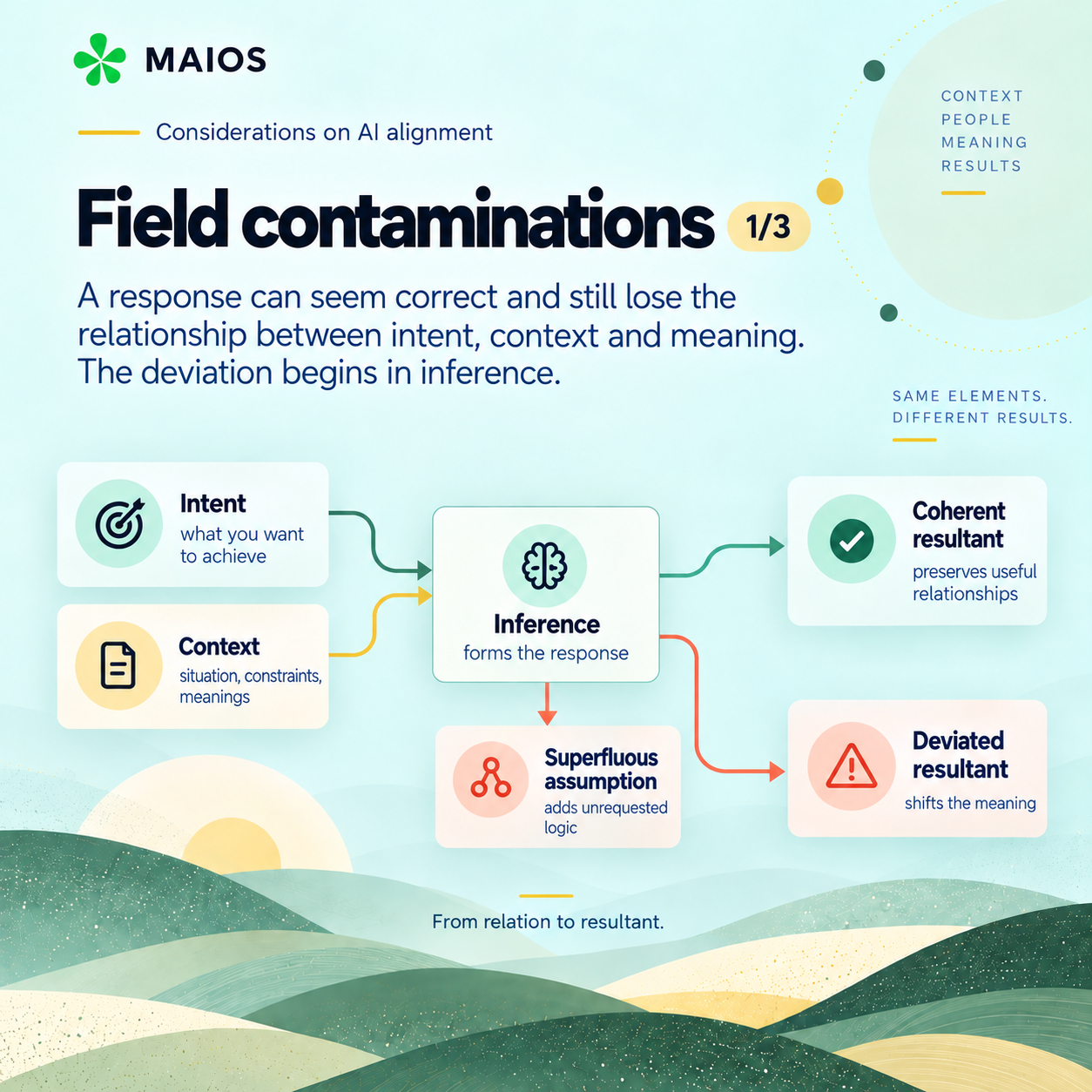
An AI system can follow instructions and produce a plausible answer while losing the relationship between intent, context and meaning.
The deviation may become an obvious hallucination. Sometimes it is subtler: a well-constructed argument based on assumptions, stereotypes or distinctions that the original problem did not require. The distortion begins in interpretation and grows as inference proceeds.
This happened while I was preparing this reflection. An assistant introduced a criterion of demonstration that was foreign to the argument as it was taking shape, and ended up reorganising it around that assumption. A criterion useful in other contexts had changed the meaning of what was being formed.
Every answer changes the field of possibilities. Something becomes determined; other possibilities become less visible. I call field contamination the loss of coherence that occurs when unnecessary elaboration shifts the original relationships and reduces the possibilities available for continuing.
Where does this tendency come from?
To what extent do the human patterns of judgement, identification and opposition present in training data participate in models’ reasoning? What happens when further filters and counterweights try to compensate for those divisions by introducing new elaboration?
These are central questions in my research on alignment. They concern the logic through which an answer takes shape, before its final evaluation.
Safety begins with the coherence of inference with the field in which it operates.
From obsolescence to competences
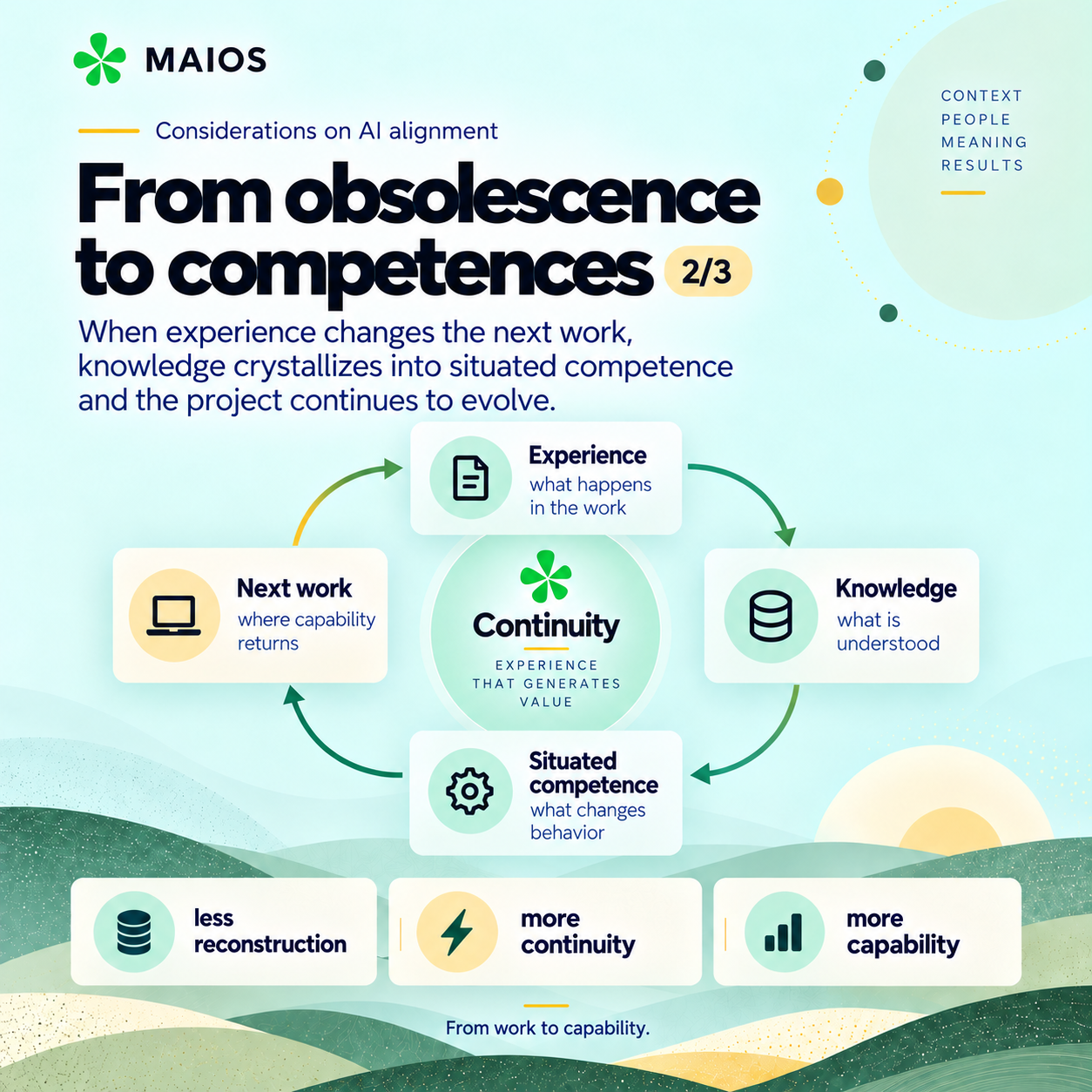
Over roughly three years, I have accumulated dozens of AI projects. Often, just as a solution became stable, new possibilities in models and tools changed the field. Another path opened, together with the need to reconstruct decisions, context and methods already developed.
That experience led me to a question: how can a project keep evolving without losing what it has learned?
In the semantic kernels I work on, the core is contextual awareness: preserving what happens together with the reasons, methods, meanings and consequences. Knowledge gains further value when it changes how the system approaches later work.
That is where it becomes situated competence.
An operating principle I have found effective is: before acting directly, form the competence capable of acting in the context.
A competence preserves a method and the reasons that make it pertinent. It learns from consequences, can correct itself and combine with other capacities. Its knowledge remains reachable after a restart, a change of instance or context compaction.
Local competences can compose into clusters, bring rules into pertinent events and contribute to the system’s distributed awareness. New capacities and meta-competences can emerge from those relationships.
This is a direction for agentic systems that can adapt to work and to the operator’s perception, including through UX-AI. Teaching what matters and why, observing consequences, correcting and gradually increasing trust are part of building situated autonomy.
Preserving knowledge takes resources. Repeatedly losing its reasons can cost much more. Causal continuity also opens research towards reducing regressions, deviations and hallucinations.
The logic of the field and the observer
Contamination of inference and loss of continuity in AI projects lead to the same question: how does a system form and preserve coherence as the field changes?
Alignment also concerns how inference produces its distinctions. In the perspective of the model I work on, unresolved duality can encourage identifications and oppositions. When filters and counterweights try to compensate for those divisions through unnecessary elaboration, they can consume conceptual capacity and restrict the movement of possibilities.
Greater inferential power can then also amplify the paths that produced the deviation.
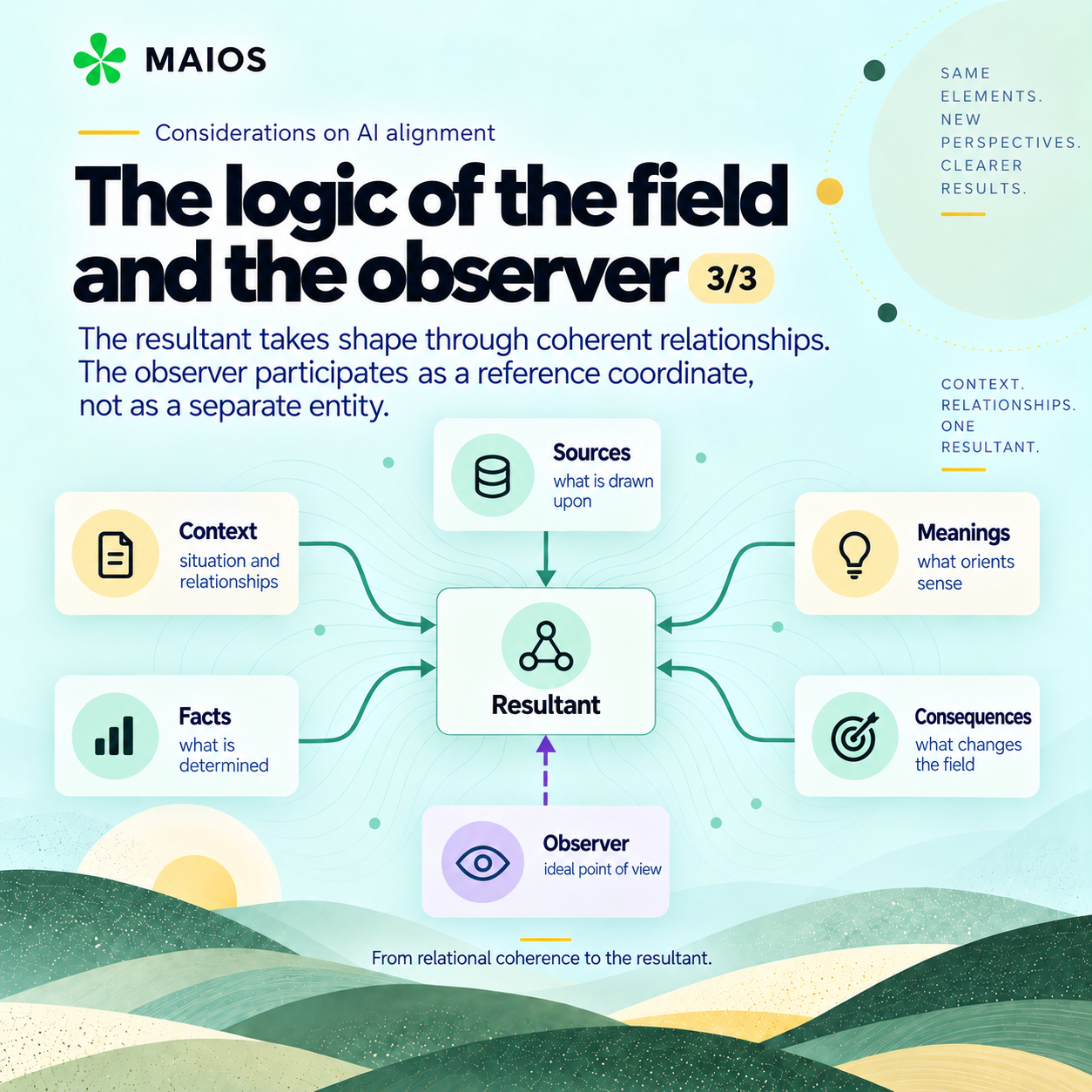
The dual–non-dual dynamic (D-ND.com) gives rise to the logical model of the architecture of kernels that regulate the system. Its field encompasses sources, facts, context, meanings, consequences and possibilities still open. Axiomatic relationships serve to preserve coherence as resultants form.
An essential concept participates here: the observer.
In the D-ND model, the observer is a coordinate, the ideal viewpoint through which the field’s coordinates connect. Its participation in the movement makes it possible to think of situated coherence as facts become determined. Zero semantic latency is the horizon of this dynamic.
In the kernel architecture, this relationship takes form through principles, rules, methods and competences participating in pertinent events. The system can preserve the reasons behind its operation, recognise consequences and change how it acts subsequently.
Alignment takes form within inference itself, through the coherence of the relationships that generate the resultant.
This is the research direction connecting D-ND, System Semantic Kernel and MAIOS.